How the Launch of Muras Will Modernize Kyrgyzstan’s Automotive Fleet
Kyrgyz market insights from the Central Asia Capital team
Anton Sobin
When analysts evaluate a region's economic potential, transportation infrastructure is a primary KPI. A nation’s automotive fleet is a direct mirror of capital distribution, the efficacy of financial instruments, and the consumer habits driving the market. When the Central Asia Capital private equity team began structuring our latest automotive venture, we leaned on hard macroeconomic data—and the numbers reveal a profound imbalance.
Eight Out of Ten Cars Require Constant Repair: Why the Market is Stuck in the Past
According to our projections, as of July 1, 2025, the share of passenger vehicles older than 15 years in Kyrgyzstan reached 81.6%. In absolute terms, that represents 1,095,900 vehicles hitting the streets every day. Effectively, eight out of every ten cars on the road have long since passed their 15-year expiration date.
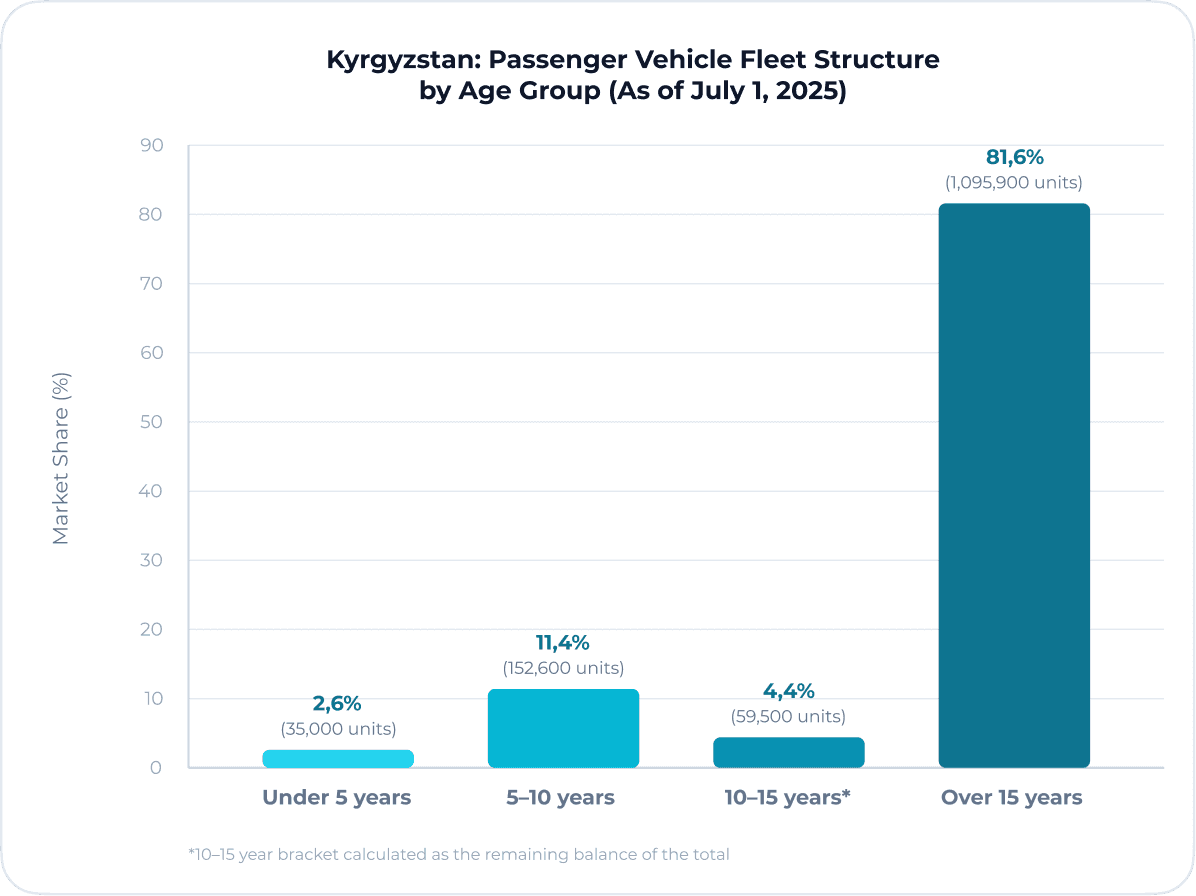
This is not a temporary glitch caused by recent global logistics crises or currency fluctuations. A 2021 benchmark of 86.6% confirms this is a persistent, systemic trend rather than a one-off anomaly.
For years, the Republic has survived by importing and maintaining aging machinery. This has created a massive "shadow market" for spare parts and a constant drain on capital, as wealth is funneled into endless maintenance rather than domestic industrial growth.
Structurally, this is a replacement market, not a primary motorization market. Basic demand is driven not by first-time buyers, but by a cycle of trading an old asset for one that is slightly less old. Consumers are essentially trapped in a "used-car paradigm."
For the Central Asia Capital team—whose families live and work in Bishkek—these figures aren't just dry slides in a deck. We see the reality: the illusion of an "affordable" used car quickly shatters against the high Total Cost of Ownership (TCO). Owners overpay for repairs, lose time at service stations, and face zero financial predictability.
This aging fleet bottlenecks related industries—from official dealership servicing to a civilized auto insurance market. To break this cycle, it isn't enough to just stimulate demand; we must shift the entire consumer culture by offering a product that disrupts the habit of buying "clunkers."
Fleet Growth of 34% in Five Years: Defining Real Demand
Despite the aging fleet, Kyrgyzstan’s automotive market remains resilient and is growing rapidly. From 2020 to 2025, the number of private vehicles rose from 1,052,670 to 1,412,613 units—a 34.2% increase over five years, with a steady CAGR of 6.1%. This proves a sustained need for mobility and an expanding ownership base.
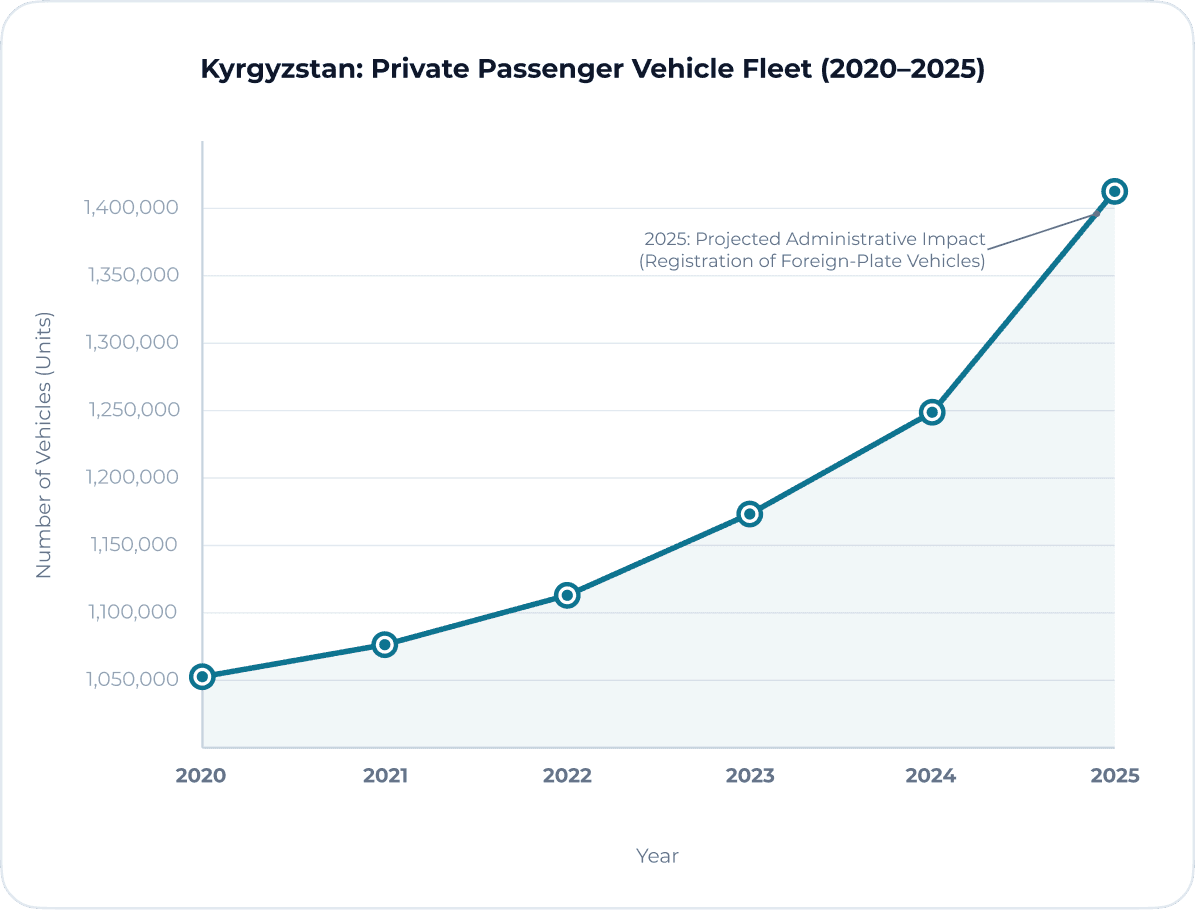
As cars wear out, the economy requires regular fleet refreshment. The baseline demand for replacement alone is between 72,000 and 96,000 units per year. Central Asia Capital views these figures as clear investment potential. We estimate the target market for new vehicles at 15,000–25,000 units annually, with 12,000–15,000 units representing a realistically achievable sales volume.
Another key indicator is the shift in import structures. In 2024–2025, analysts noted a 39% drop in the average price of imported vehicles. This signals that buyers are aggressively seeking more affordable options.
This environment is perfect for introducing a National Brand rather than an old import—a new vehicle with a predictable cost of ownership.
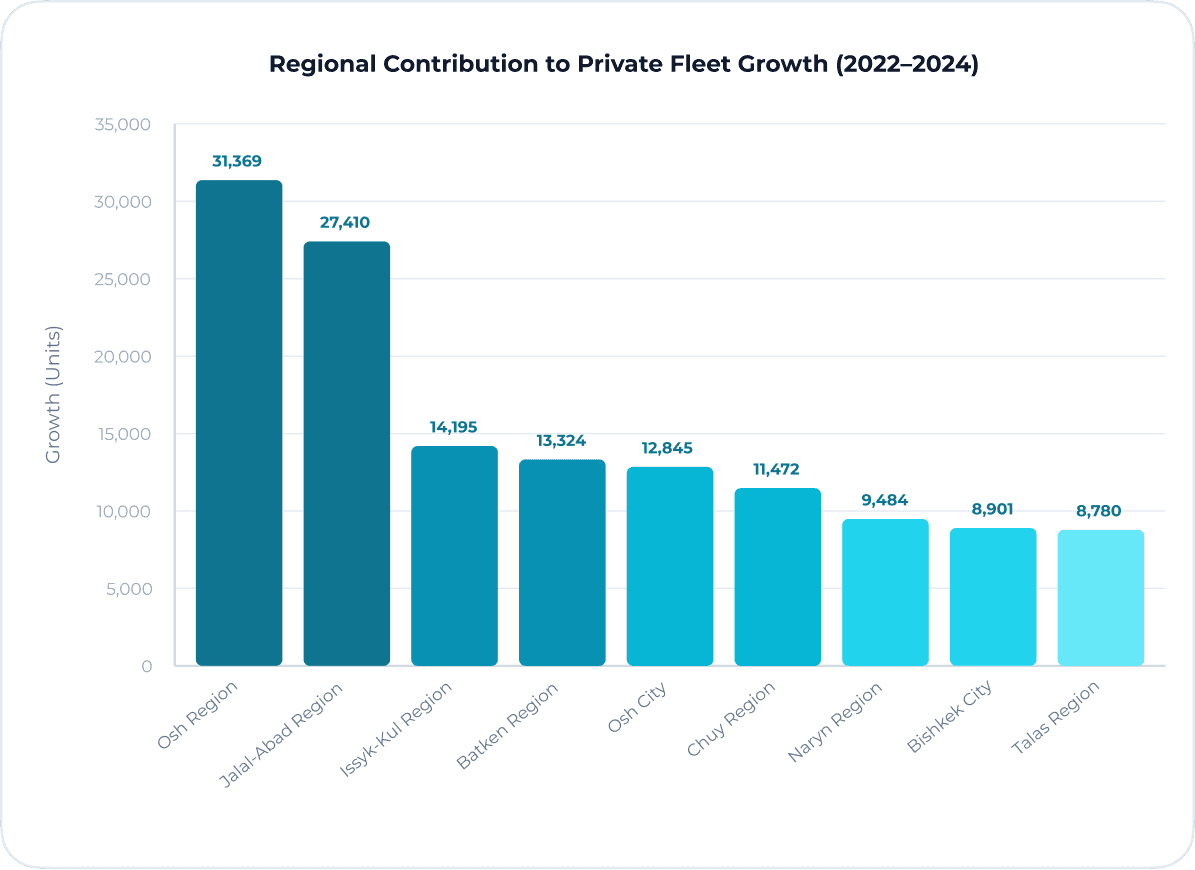
Notably, motorization is being driven by the regions, not just the capital. Data from 2022–2024 shows that the Osh and Jalal-Abad regions contributed most to fleet growth (22.8% and 19.9% respectively). This geographic spread validates our strategy: we can scale sales through regional expansion, providing reliable, affordable vehicles for everyday life and work across the country.
The New Muras: Outperforming Imports on Cost of Ownership
The ultimate goal of Central Asia Capital’s automotive project is to foster a new consumer culture. We want to help people move away from "forced" used-car purchases. The Muras brand enters the market with a clear value proposition: The Most Affordable "People's Car" of the Kyrgyz Republic.
Projected Price (at 50% localization): ~997,500 KGS ($11,100)
Launch Price (SKD Assembly): ~1,045,000 KGS ($11,600)
This is significantly more competitive than current market alternatives. For comparison, a new budget vehicle from a competing brand costs roughly 1,220,000 KGS ($13,500).
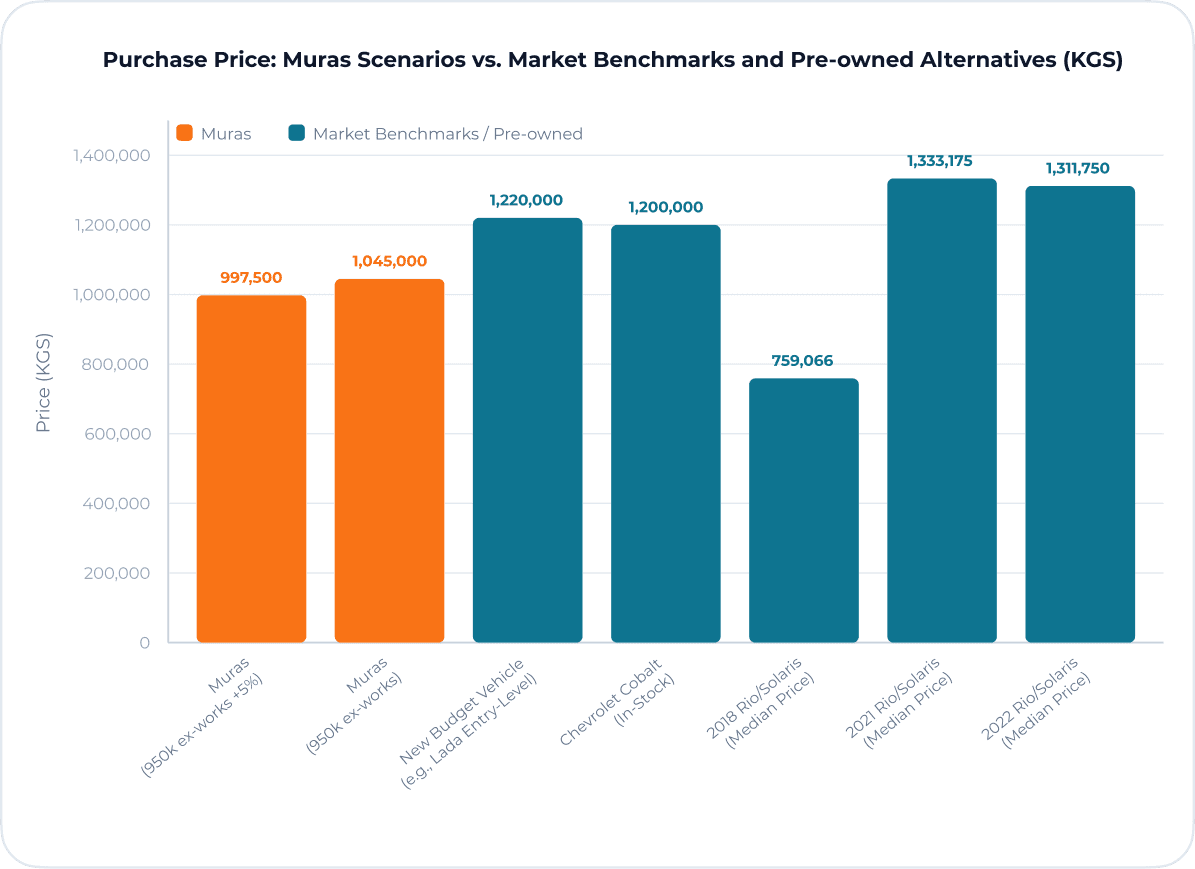
Muras also wins against "fresh" used cars. For instance, the median price for a 2022 model like a Rio or Solaris is currently around 1,311,750 KGS ($14,600). While a 2018 model might be cheaper upfront (~759,066 KGS / $8,400), the Total Cost of Ownership for a Muras remains lower. A new car owner eliminates the risk of sudden breakdowns and enjoys predictable maintenance costs.
Furthermore, we are leveraging modern finance. While banks are often hesitant to finance older used cars, Central Asia Capital is implementing a subsidized interest rate program via leasing for Muras. This lowers the monthly financial burden for families, making the transition to new, safe transport a mass-market reality.
The Macroeconomic Impact of Domestic Production
Launching a national car is an economic solution to a systemic market failure. Central Asia Capital is building a mechanism to stop the "capital burn" associated with maintaining foreign scrap metal. We are offering a pragmatic choice: instead of endless repair bills, citizens gain a reliable asset and predictable expenses.
Every Muras on the road represents capital staying within the country, hundreds of new jobs, and a catalyst for adjacent industries. In this way, a new car evolves from an inaccessible luxury into an economically sound—and safe—standard of living.
See also
Other news
All news