When analysts assess the economic potential of a region, the quality of transport infrastructure becomes one of the main indicators. The country's vehicle fleet directly shows how capital is distributed, how effectively financial instruments work, and what consumer habits drive the market.
Before launching a project in the automotive industry, the team from the direct investment fund Central Asia Capital conducted a deep analysis of the Kyrgyz market. The presented macroeconomic data indicates a serious imbalance in the industry. We share key facts from our analytical review.
Eight out of ten cars require constant repairs. Why the market is stuck in the past
According to our calculations, as of July 1, 2025, the share of passenger cars older than 15 years in Kyrgyzstan was 81.6%. In absolute terms, this is 1,095,900 cars that daily hit the streets of our cities. This means that eight out of ten vehicles on the country's roads have long surpassed their fifteen-year milestone.
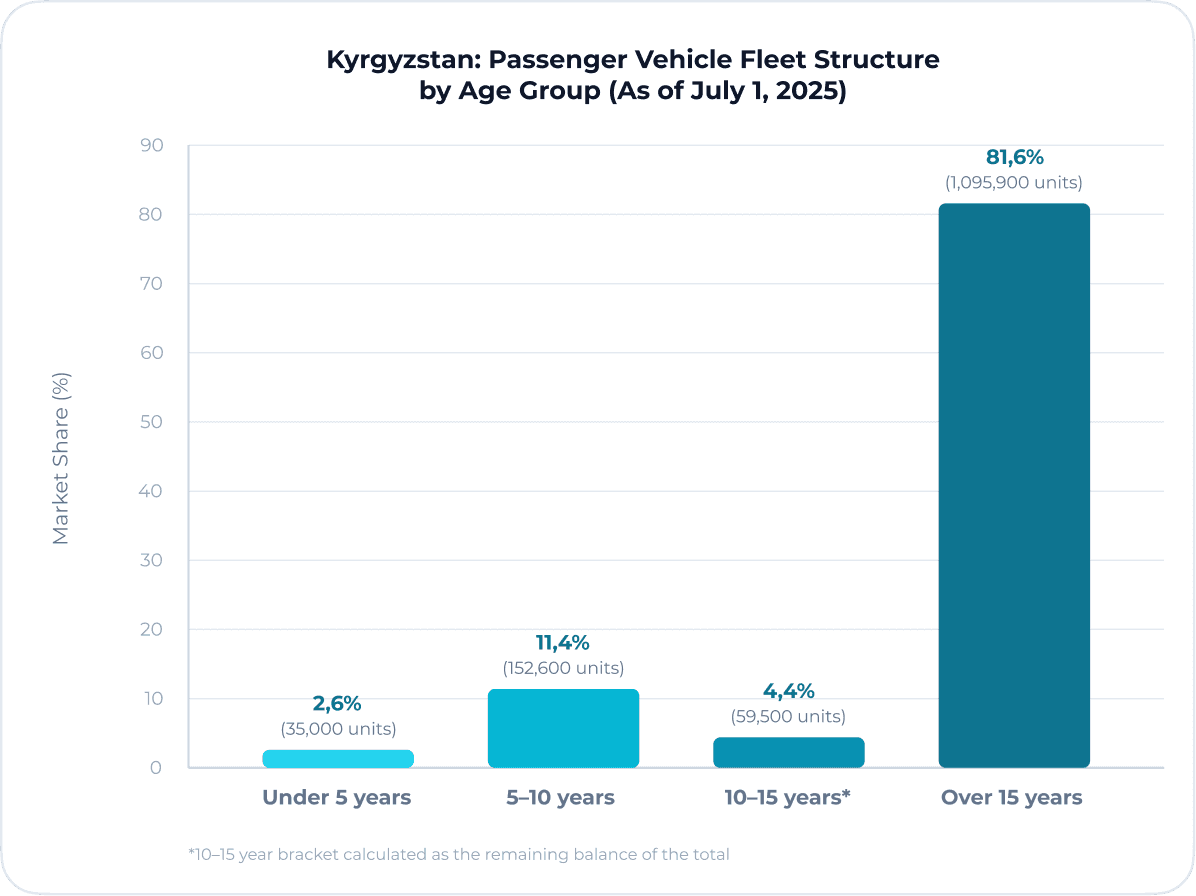
This situation is not a temporary glitch due to recent global logistics crises or fluctuations in currency exchange rates. A comparable benchmark from 2021 confirms the sustainability of the trend: at that time, the share of cars older than 15 years was 86.6%. The problem of the old vehicle fleet is systemic rather than one-off.
For years, the Republic has been importing and maintaining aging equipment. This creates a huge shadow market for spare parts and a constant outflow of capital abroad, as money goes towards endless servicing of cars rather than developing local industry.
By its structure, this is a replacement market rather than primary motorization. Basic demand is not driven by people who are buying their first car but by a constant cycle of exchanging old assets for slightly less old ones. Consumers are tightly locked in the paradigm of the secondary market.
For the team at Central Asia Capital, whose families live and work in Bishkek, these figures are not just dry statistics from presentations. We see the real picture: the illusion of the availability of a used car quickly shatters against the high total cost of ownership. Owners overpay for repairs, waste time at service centers, and cannot predict their financial expenses at all.
An old vehicle fleet hinders the development of many related industries, from official dealership services to a civilized auto insurance market. To break this vicious circle and put the economy on new rails, the country cannot simply stimulate demand. It is necessary to completely change the culture of consumption by offering the market a product that will break the habitual pattern of buying old cars.
The vehicle fleet has grown by 34% over five years. Who shapes the real demand for new cars
Despite the outdated vehicle fleet, the automotive market in Kyrgyzstan remains lively and is rapidly growing. From 2020 to 2025, the number of personal cars increased from 1,052,670 to 1,412,613 units. The growth over these five years amounted to 34.2%, while the compound annual growth rate (CAGR) confidently holds at 6.1%. This proves that there is a stable need for mobility among the population, and the base for vehicle ownership is constantly expanding.
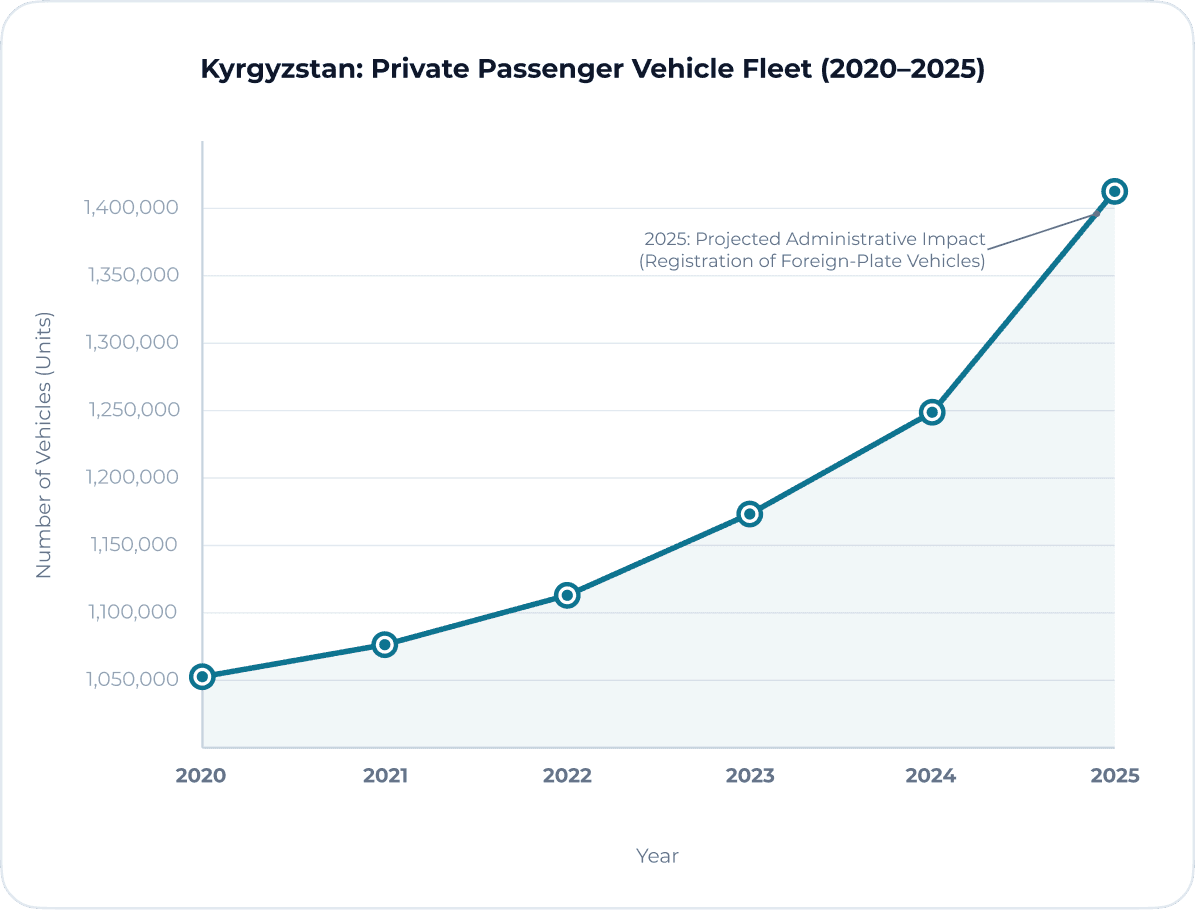
Cars are wearing out, so the economy requires regular renewal of the vehicle fleet. The basic demand for replacing retiring cars amounts to between 72,000 and 96,000 units per year. The Central Asia Capital team sees clear investment potential in these figures. If we assess the target market specifically for new cars, its total volume reaches 15,000–25,000 vehicles annually. Of these, 12,000–15,000 units is a realistically achievable sales volume.
Another important marker of the market's readiness for change lies in the structure of imports. In 2024–2025, analysts recorded a significant reduction in the cost of imported vehicles: the average price of deliveries fell by 39%. This directly indicates a change in the price composition of the imported cars. Buyers are actively seeking more affordable options.
Such an environment is perfect for offering people not an old imported product, but a new national car with predictable ownership costs.
It is important to understand that the driver of motorization is not only the capital but also the regions. Analysis from 2022 to 2024 shows that the largest contribution to the growth of the vehicle fleet came from the Osh and Jalal-Abad regions. The Osh region accounted for 22.8% of the growth, or 31,369 vehicles. The Jalal-Abad region added another 19.9%—that is, 27,410 vehicles.
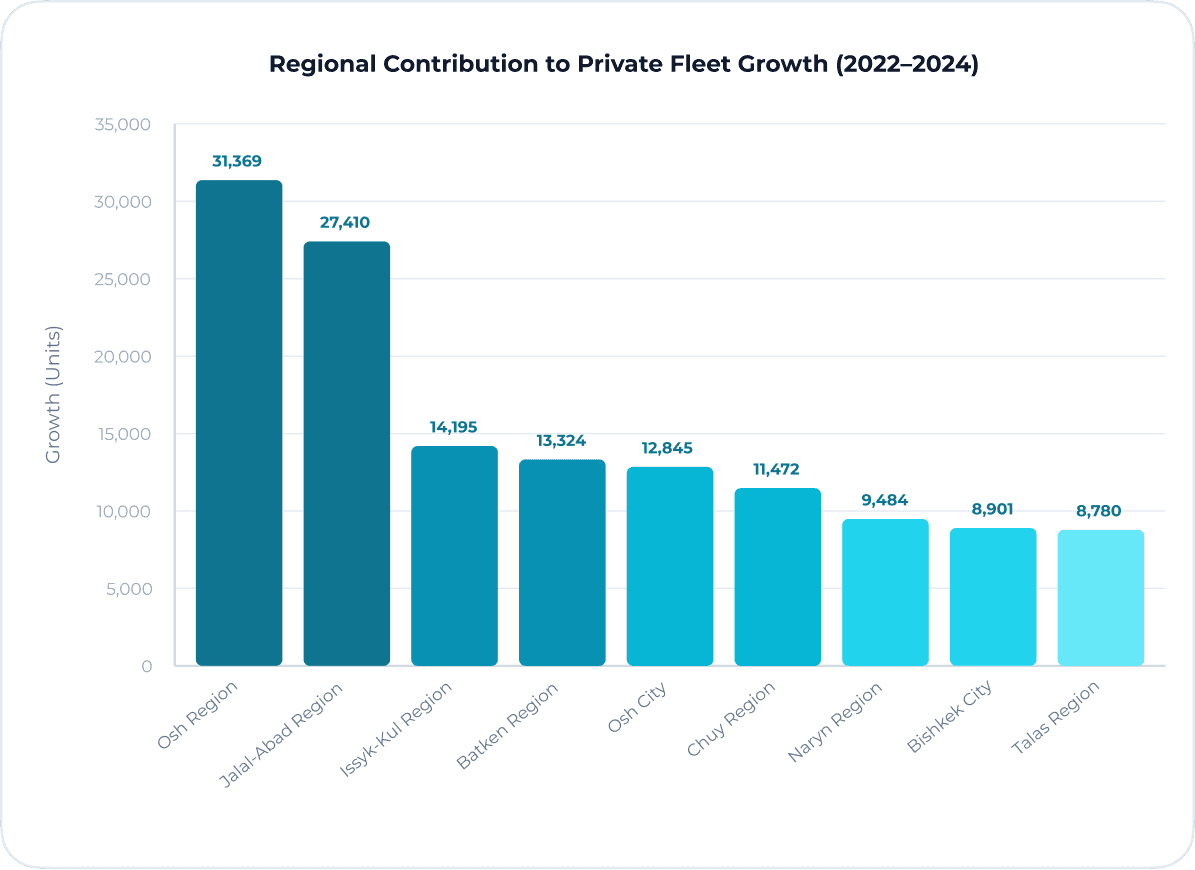
Such a geography of demand confirms the investment strategy: we can confidently increase sales through regional expansion. Residents across the country need reliable and affordable vehicles for everyday work and life.
The new Muras is cheaper than fresh foreign cars. How we reduce the cost of car ownership
The main goal of the Central Asia Capital direct investment fund's automotive project is to form a completely new culture of consumption. We want to help people move away from the forced purchase of used cars and choose new vehicles instead. The Muras brand is entering the market with clear positioning: it is the most affordable people’s car in the Kyrgyz Republic. It provides the minimum entry price into the new transport segment.
The expected price for the Muras, after achieving 50% localization, will be 997,500 soms. At the start of the project, when the factory uses large-unit assembly, the price will be fixed at 1,045,000 soms. This is significantly more advantageous than similar offers in the market. For comparison: the purchase of a new budget car of another brand will cost around 1,220,000 soms.
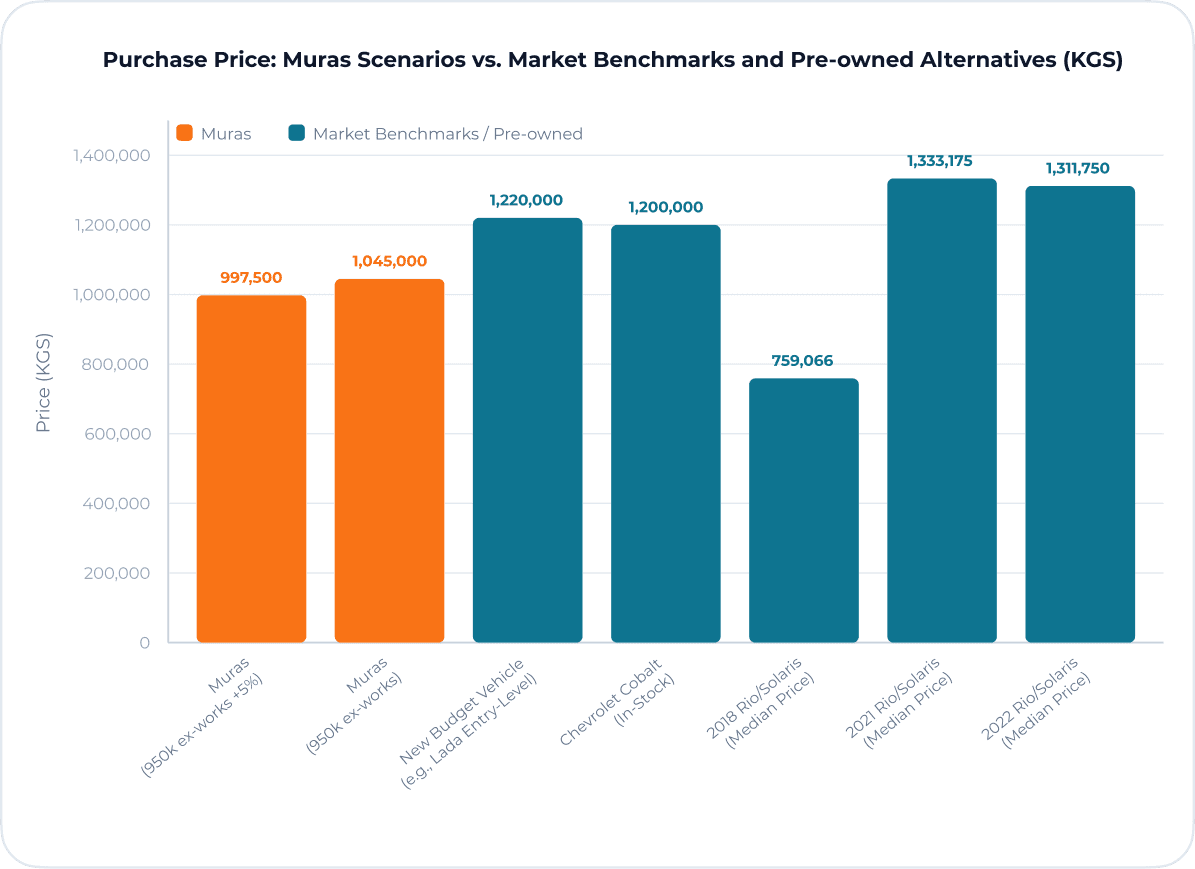
The Muras easily wins competition even against fresh used alternatives. Analytics show that the median price of a popular model, for instance, a Rio or Solaris of the 2022 model year, currently stands at 1,311,750 soms.
Of course, there are also older options on the market. A 2018 car will cost less upon purchase—about 759,066 soms. However, the total cost of ownership for the Muras still turns out to be lower. The buyer of a new car frees themselves from sudden breakdowns and obtains predictable expenses for spare parts and maintenance.
Another powerful lever is access to modern financing. Purchasing a new car opens up a wide range of financial instruments for clients, which are unavailable for older vehicles. Banks are reluctant to finance the purchase of used cars, but for the Muras fund, a subsidized interest rate program through leasing is being implemented. This reduces the monthly financial burden on families and makes the transition to new, safe transport genuinely mass-market.
How local production impacts the economy of Kyrgyzstan
The launch of a national car is an economic response to a systemic market problem. The Central Asia Capital fund is building a mechanism that will help the republic stop burning capital on servicing someone else's aging vehicle fleet. We offer a pragmatic choice: instead of endless expenses on repairing used cars, people receive a reliable asset and predictable operating costs.
Every new Muras on the roads means money that stays working within the country, hundreds of new jobs, and a strong stimulus for related industries. Thus, a new car transforms from an inaccessible luxury into an economically justified and safe norm.