
Technological leadership is a fundamental condition for economic survival. The Ministry of Economic Development defines it as a country's capacity to create and adopt technologies faster than competitors, driving productivity and global market share.
In Russia, the IT sector accounts for 2,4% of GDP, excluding multiplier effects on adjacent industries. However, the country ranks 60th in the Global Innovation Index 2025, commercializing 7% of patents with R&D spending at 1% of GDP. The primary market constraint is an implementation barrier, rather than a deficit of scientific research.
Valley of death and structural barriers
Most technology projects face a valley of death between pilot and commercial scaling. At this stage, companies require long-term capital, management expertise, and investors willing to share structural risks.
Several factors impede the transition from development to a stable business:
Talent shortage remains the primary barrier, cited by 44% of enterprise executives when implementing digital solutions.
Limited local market capacity prevents companies from achieving the economies of scale required for a return on investment.
Access to long-term capital remains constrained for companies with proven technology.
State development institutions like VEB.RF form the foundation to overcome these barriers. Their 2030 strategy prioritizes technological leadership with total funding exceeding 30tn RUB. VEB coordinates the state, banks, and businesses. However, institutional efforts alone cannot close the gap between science, the labor market, and private capital requirements during the scaling phase.
Central Asia as a growth platform
When the domestic market limits capital appreciation, integration with neighboring economies becomes critical. The EAEU and the growing Central Asian market serve as platforms for the geographic expansion of Russian technology companies.
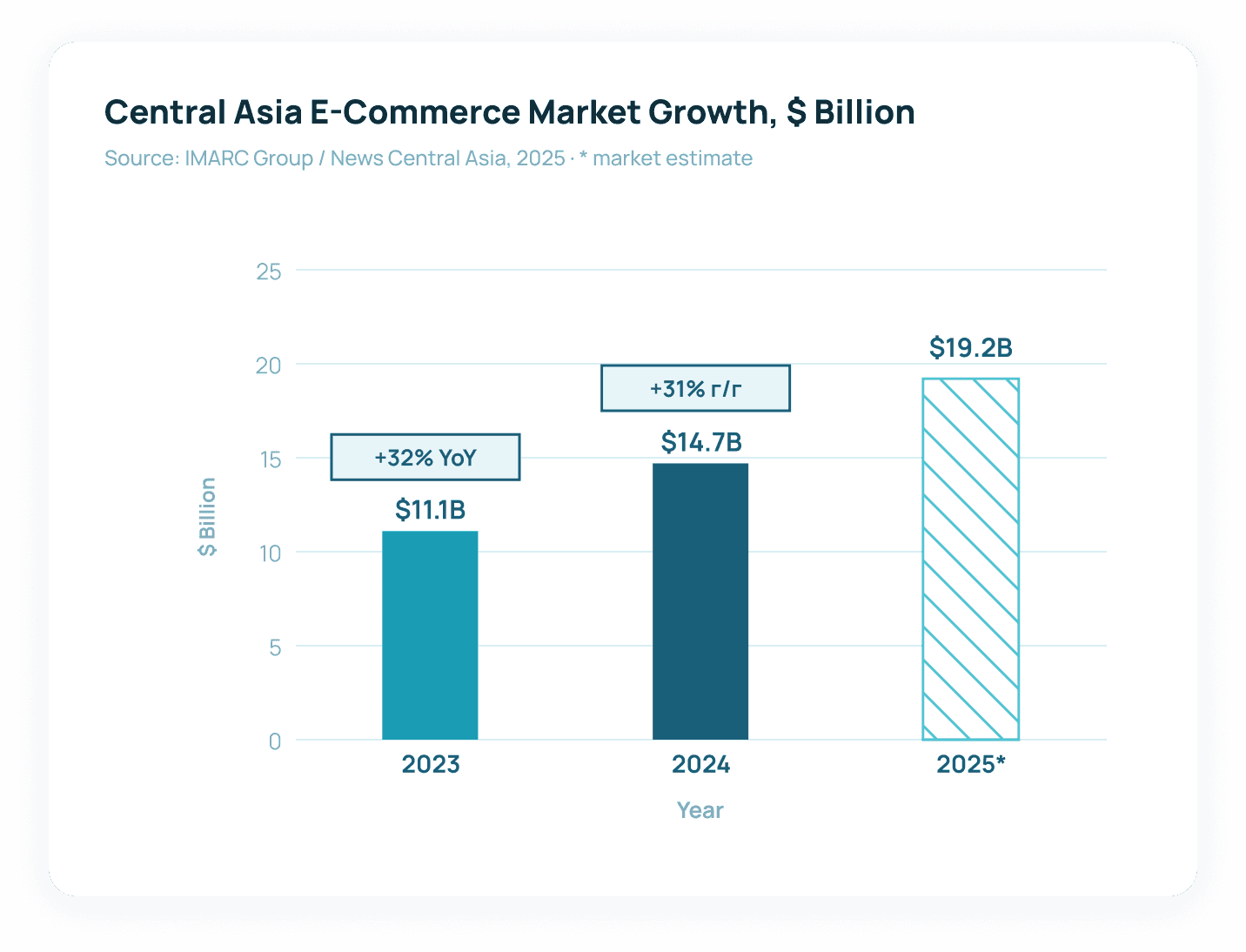
Macroeconomic indicators confirm market capacity. Central Asian e-commerce volume reached 14,7bn USD in 2024, reflecting a 32% YoY growth. IMARC Group estimates the market exceeded 19,2bn USD in 2025. Demand is forming for fintech products, digital government services, and B2B solutions. This creates opportunities for proven technologies positioned for geographic diversification.
Entering these emerging markets requires smart co-financing mechanisms rather than capital injection alone. Private equity funds and private investors provide local market intelligence and structured entry into new jurisdictions. Capital deployment enables the transformation of technological potential into market value.
Within this framework, Central Asia Capital partners with institutional capital to facilitate structured entry into the Kyrgyz market. Going beyond regional potential assessment, the firm builds an asset portfolio leveraging local market intelligence. For investors pursuing geographic diversification, the fund provides an institutional framework and aligns interests across the investment lifecycle.
See also
Other news
All news