
Central Asia has become one of the fastest-growing macro-regions in Eurasia, with aggregate GDP exceeding 500bn USD and a consumer market of roughly 60M people. Shifting investment flows require capital to move from one-off, opportunistic deals toward a defined operating model.
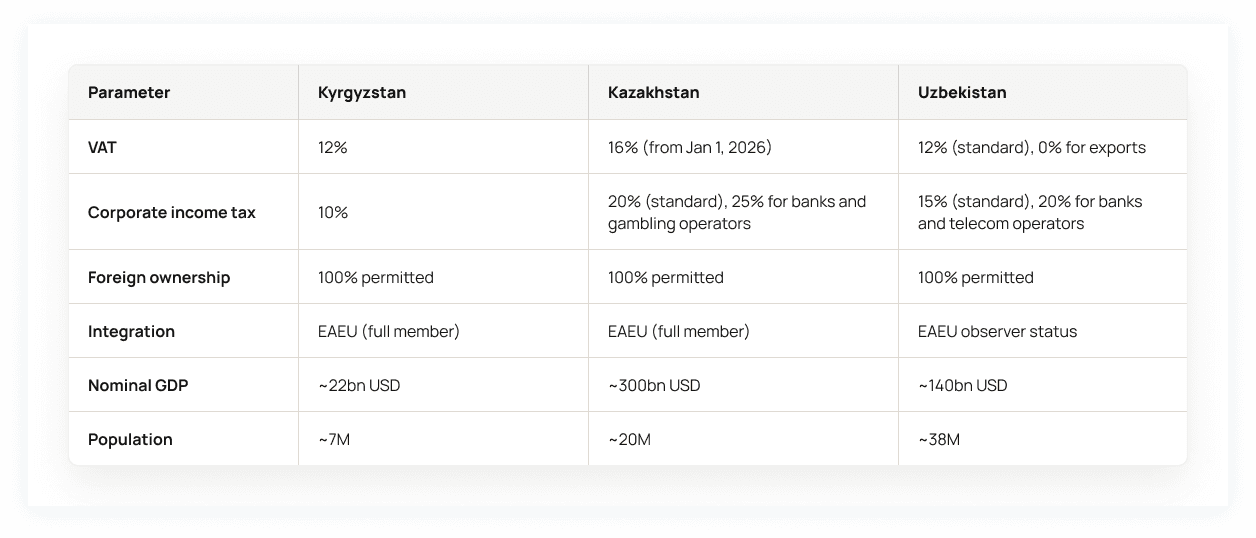
Kyrgyzstan, Kazakhstan, and Uzbekistan offer fundamentally different operating conditions in terms of tax burden, institutional maturity, and integration into international trade chains.
Three entry scenarios for the region
Kyrgyzstan: fast market entry and access to the EAEU common market
The jurisdiction provides the lowest aggregate tax burden in the region: the base VAT rate is set at 12%, corporate income tax at 10%, alongside moderate social insurance rates.
As an alternative to the standard tax system, operating businesses can opt for a single tax regime at 2–6% of revenue. Since August 2025, turnover caps for this regime have been removed; it does not apply to the financial, excise, or mining sectors. Combined with moderate property and land tax rates, this allows project companies to materially reduce their effective tax burden and free up working capital.
The law provides for full foreign ownership and control of assets, and preferential industrial zones and parks compress the launch cycle for production sites (greenfield/brownfield) to 3–6 months.
The key institutional advantage is full membership in the Eurasian Economic Union. This gives export-oriented producers duty-free access to the common market, unified technical standards, and participation in the union's public procurement system. Kyrgyzstan's GDP grew above 11% in 2025, driven by industry, construction, and trade, and the country is rolling out SME support programs modeled on JICA's framework. The number of registered companies with Russian participation rose 70% over two years.
Kazakhstan: institutional depth and scale
Kazakhstan is the region's largest economy, with nominal GDP of about 360bn USD and annual foreign trade exceeding 150bn USD. The investment environment is administered centrally through the Investment Headquarters, providing developed logistics and access to a mature financial market.
Cumulative FDI from Russia has reached about 30bn USD, with a joint project portfolio exceeding 50bn USD, including three coal-fired power plants with roughly 1 GW of combined capacity built by Inter RAO — Export and distribution centers for Ozon and Wildberries worth 204M USD. However, the market's scale comes with a higher tax burden (VAT rising to 16% from 2026), intense competition, and strict compliance controls on cross-border banking transactions.
Uzbekistan: a large domestic market and targeted incentives
With a population of over 38M and foreign trade turnover exceeding 80bn USD, Uzbekistan is the largest consumer market in Central Asia. The government incentivizes localization through special economic zones, offering exemptions from certain taxes for up to 10 years and a zero VAT rate for IT services exporters.
Operating in the local market requires navigating specific regulatory conditions: close engagement with government agencies, currency controls, and longer approval cycles for investment projects.
The economic effect of EAEU integration
Kyrgyz and Kazakh membership in the EAEU gives export-oriented producers access to the common market on the same terms as local manufacturers elsewhere in the union, at a substantially lower operating and tax cost base.
Investment activity in the real economy confirms this model's effectiveness:
Energy and refining. Gazprom's long-term investment program, worth 32bn KGS (over 360M USD), lifted the country's gasification rate from 22% to almost 40%, while the technological upgrade of the Junda refinery brought deep processing capacity up to 800K tons of fuel per year.
Light manufacturing. Kyrgyzstan's garment exports totaled 112M USD in 2024, with over 80% destined for Russia. Shipments doubled in early 2025, transforming local factories into a key production cluster for the region's largest marketplaces.
Operating filters and sector selection
Investment performance in the region hinges on two decisions made at the deal structuring stage.
Focus on sectors with low exposure to external risk. Import-substituting production of basic goods, agribusiness, and niche IT products serving domestic demand across the macro-region show the highest resilience.
Institutional local partnerships. Navigating regulatory and informal barriers requires working with local investment partners with a proven operating track record and administrative expertise.
Corporate structuring and risk management
Long-term value preservation in Central Asia rests on a comprehensive risk management framework.
Multi-tier corporate structuring. Risk isolation through local special purpose vehicles (SPVs) controlled by holding structures. Kyrgyz law, which permits 100% foreign ownership, allows for a clean separation of asset and operating risk.
Contractual exit provisions. Shareholder agreements lock in put and buyback options, management buyout terms, and rights of first refusal for strategic investors. For larger, scalable projects, a public listing on the AIX or KASE exchanges is under consideration.
Institutional stakeholder engagement. Integration into state development programs, partnerships with leading universities for talent development, and local hiring support the asset's social license and reduce regulatory risk at the local level.
Central Asia will remain one of Eurasia's most dynamic markets in the coming years, and competition for high-quality assets will keep intensifying. Investors who move from one-off deals to systematic direct investment — with localized production, transparent capital structuring, and reliable regional partners — are positioned to capture sustainable returns.
See also
Other news
All news